
For thirty years, the business world has used the wrong word to describe what technology does. We say technology “disrupts” industries, as if it were a storm passing through — damaging, dramatic, but ultimately temporary. The old industry suffers, adapts, and then resumes its old shape with a few new tools bolted on.
That is not what happens.
What actually happens is quieter, slower, and far more total. Technology does not disrupt industries. It absorbs them.
Disruption implies a contest between two competitors in the same arena: the old taxi company versus the new taxi app, the old bank versus the new fintech, the old retailer versus the online store. Absorption is different. Absorption means the arena itself is rebuilt in software. The industry does not merely lose market share to a technology company. The industry becomes a technology system — or it becomes a feature inside someone else’s technology system.
This is the master thesis of the Brooker worldview, the umbrella under which everything else we believe about markets, capital, and corporate strategy sits. Once you see absorption rather than disruption, a great deal of confusing market behavior becomes legible. Why does a car company trade like a software platform? Why does a bank behave like a cloud company? Why do retailers become logistics networks? Why do media companies lose not to better magazines, but to algorithmic feeds? Why do the largest companies in the world appear to operate across industries that used to be separate?
Because the boundary between industries is dissolving. Software is not entering industries. Software is becoming the substrate on which industries run.
Marc Andreessen’s famous 2011 line — “software is eating the world” — was correct, but the next stage is more comprehensive. Software first ate the front end: the interface, the website, the app, the distribution channel. Now AI, cloud, data, robotics, digital payments, and blockchain are absorbing the back end: pricing, settlement, credit, underwriting, logistics, compliance, manufacturing, customer service, and eventually management itself.
That is why “digital transformation” is too weak a phrase. Transformation sounds optional. Absorption is structural.
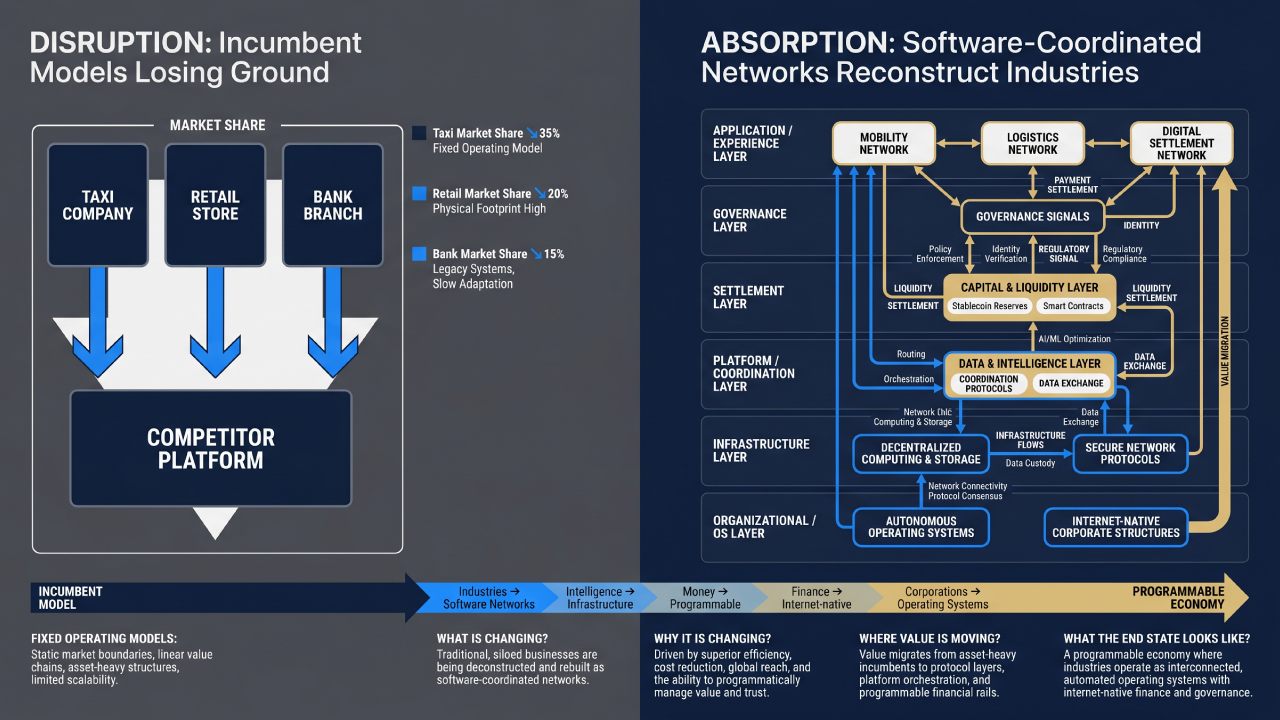
The universal solvent
Think of technology not as a sector but as a universal solvent — a force that dissolves the boundaries of whatever it touches and re-forms it as a programmable, software-driven network.
Media was absorbed first. The newspaper did not lose to a better newspaper. It lost to a feed — a software system that performs the function of news distribution as one feature among thousands. Advertising followed the same path. The old advertising industry sold attention through agencies, television slots, print circulation, and billboards. The new advertising industry is an auction-driven data network in which attention is priced, targeted, measured, and optimized in real time.
Retail followed. The department store did not lose to a better store. It lost to a logistics-and-software network that happens to sell things. Amazon is not merely a retailer; it is a demand prediction engine, seller marketplace, fulfillment network, cloud computing platform, advertising exchange, subscription bundle, and AI infrastructure company. Its retail surface is visible. Its absorption power sits underneath.
Transportation followed. Uber did not merely compete with taxis. It turned mobility into a software-coordinated liquidity pool: drivers, riders, prices, maps, routing, incentives, payments, food delivery, freight, advertising, and subscriptions. The taxi market was the entry point; the software network became the real business.
Hospitality followed. Airbnb did not build hotels. It absorbed the function of hotel inventory creation by coordinating trust, discovery, payments, identity, pricing, and reputation across millions of privately owned assets. It did not need to own the rooms because the network owned the coordination layer.
The pattern is always the same:
- Software first handles a peripheral function — a website, an app, a dashboard, a digital channel.
- Software then begins to handle the core function — underwriting, routing, pricing, diagnosis, settlement, matching, fulfillment.
- The industry’s economics invert: physical assets, licenses, branches, fleets, stores, and legacy relationships become less valuable than the software network that coordinates them.
- At the end, the industry has not been disrupted. It has been re-architected.
The solvent is now working on the sectors that looked too regulated, too physical, or too entrenched to dissolve: banking, insurance, automotive, logistics, healthcare, energy, education, real estate, and the corporation itself.
Why the market keeps misclassifying winners
Financial markets often misprice absorption because analysts insist on valuing the new organism as if it were still the old category.
Tesla is the cleanest example. Tesla is not simply a car company that uses software. It is a software, energy, autonomy, data, manufacturing, and robotics network that uses cars as one of its endpoints. The car is the hardware shell. The value lies in the data loop, over-the-air updates, charging network, battery ecosystem, autonomy stack, manufacturing architecture, and optionality into robotics and energy storage. Traditional auto analysts who valued Tesla only on units sold and gross margin per vehicle were measuring the shell and missing the network.
The same error shows up in banking. JPMorgan Chase is usually described as America’s largest bank. That is true legally, but strategically incomplete. JPMorgan is an enterprise software and data company with a banking license. It reported an annual technology spend of roughly US$17 billion and more than 63,000 technologists — numbers that would make it one of the world’s most serious technology organizations even if it did not call itself one. Its competitive battles are fought in payment rails, fraud systems, data infrastructure, digital onboarding, cloud migration, AI workflows, tokenized settlement, and institutional client platforms. The branch network still matters. But the platform layer matters more every year.
This is not isolated. The world’s most valuable healthcare companies increasingly look like data and AI businesses with clinical capabilities attached. The most valuable logistics firms are valued on routing algorithms, network density, and data feedback loops rather than trucks. Energy companies are becoming grid optimization and power trading software systems. Even defense is being absorbed into software: drones, autonomy, sensor fusion, simulation, cyber, targeting, and AI command systems.
The market’s recurring mistake is category nostalgia. It looks at the visible product and assigns the old industry multiple. But the value migration is in the invisible coordination layer.
Static TAM analysis misses absorption
Absorption also explains one of the most persistent errors in investment analysis: static total-addressable-market thinking.
When an industry is merely being disrupted, the TAM stays roughly constant. A new entrant takes share from an old incumbent. The pie is the same; the owner changes.
When an industry is being absorbed, the TAM expands because the software network does not stop at the original use case. It absorbs adjacent functions, creates new behavior, and bundles markets that were previously separate.
Analysts who sized ride-hailing against the taxi market missed the point. The software network expanded from taxis into private car substitution, food delivery, logistics, advertising, subscriptions, and eventually autonomous mobility. Analysts who sized streaming against DVD rentals made the same error. Streaming absorbed not only video rental but cable bundles, original production, global distribution, fan data, advertising inventory, and attention itself.
The same error is happening now. Stablecoins are not merely a crypto trading tool; they are absorbing parts of cross-border payments, dollar savings, Treasury demand, machine commerce, and settlement. AI agents are not merely the chatbot market; they are absorbing research, drafting, coding, customer service, compliance, reporting, software testing, and internal operations. Tokenization is not merely “putting assets on-chain”; it is absorbing settlement, ownership records, investor communications, liquidity, governance, and incentives.
The investment discipline is to ask a different question. Not: “How big is this market today?” But: “Which functions will this network absorb next?”
That question is uncomfortable because it breaks the spreadsheet. But it is precisely where the largest returns live. The biggest winners in an absorption economy are systematically underestimated early because the analyst anchors on the legacy industry’s size while the network is quietly expanding into adjacent pools of value.
The counterargument: physical industries still matter
The obvious objection is that software cannot replace everything. Cars still require factories. Energy still requires power plants. Healthcare still requires doctors, hospitals, devices, and regulated clinical judgment. Logistics still requires ports, warehouses, roads, trucks, and aircraft. Banking still requires regulation, capital, risk controls, and trust.
This objection is correct — and it misses the economic point.
Absorption does not mean atoms disappear. It means atoms are coordinated by software. Physical assets remain necessary, but they increasingly become endpoints in a programmable system. The factory matters, but the manufacturing operating system matters more. The warehouse matters, but the routing and demand prediction system matters more. The bank license matters, but the digital rail, data layer, and compliance automation matter more. The hospital matters, but the diagnostic data loop, AI triage, remote monitoring, and workflow architecture matter more.
The winners are not pure software abstractions floating above the real world. The winners are hybrid organisms that fuse software with physical infrastructure and then use the software layer to extract more value from the physical layer than competitors can.
Tesla did not ignore manufacturing; it re-architected manufacturing around software. Amazon did not ignore warehouses; it turned warehouses into programmable logistics nodes. JPMorgan did not ignore regulation; it turned compliance, risk, data, and client access into software-driven scale advantages. The physical world remains. But its economics are increasingly determined by the software layer that coordinates it.
What this means for Thailand and Southeast Asia
For Thai conglomerates and regional family businesses, the absorption thesis is not an abstraction. It is a strategic clock already running.
Southeast Asia’s largest business groups were built on physical and regulatory moats: land banks, distribution networks, retail footprints, bank relationships, licenses, local operating knowledge, and trust accumulated over generations. These moats were genuinely defensible against old-style disruption. A foreign competitor could not easily replicate decades of local infrastructure.
But absorption does not always attack the moat directly. It makes the moat less relevant by shifting value into a software layer above it.
A retail conglomerate’s physical footprint matters less when discovery, payments, loyalty, and fulfillment are coordinated by platforms. A bank’s branch network matters less when deposits, settlement, credit scoring, and treasury flows move onto digital rails. A media group’s broadcast license matters less when attention moves to algorithmic feeds. A real estate group’s land bank matters less if demand formation, financing, tokenized ownership, and customer relationships are owned by another platform.
The question for every major Thai enterprise is no longer whether its industry will be absorbed. It is whether the company will be the absorber or the absorbed.
Becoming the absorber requires a deliberate technology absorption strategy. Management must identify which core functions can be rebuilt as software networks, which customer relationships can become data loops, which physical assets can be made programmable, which partnerships provide access to frontier technology, and how capital allocation must shift from physical expansion to platform construction.
The board-level test is brutal:
- Is technology treated as a cost center or a value migration strategy?
- Is data treated as exhaust or as compounding infrastructure?
- Is distribution owned or rented?
Are workflows digitized only at the interface, or rebuilt at the core? - Does the company have direct exposure to the builders absorbing its industry?
Absorption as an investment framework
This thesis is also why Brooker structures its frontier technology exposure through venture access, fund-of-funds positioning, treasury strategy, and direct engagement with builders of absorption-layer technologies: AI, blockchain infrastructure, robotics, programmable finance, and digital asset rails.
If technology is a universal solvent rather than a sector, then “tech investing” is not a portfolio sleeve. It is a view on where every industry’s value is migrating.
The venture ecosystem is an early-warning system. It shows which functions of which industries are being rebuilt in software years before public markets price them properly. Venture managers see the early symptoms: new rails, new workflows, new protocols, new distribution models, new developer behavior, new customer interfaces, new forms of capital formation. Exposure to that ecosystem is exposure to the absorption process itself.
This reframes risk. The riskiest position in an absorption economy is not necessarily owning early-stage technology. The riskiest position may be owning mature, profitable incumbents whose core functions are quietly being rebuilt by someone else’s software. These businesses look stable precisely because absorption has not yet reached their income statement.
By the time the disruption is visible in revenue decline, the absorption already happened in the architecture.
The clean test
Here is the simple test Brooker applies to any company, sector, or market narrative:
Is this business becoming a programmable network, or is it being turned into a feature of someone else’s programmable network?
Every industry eventually answers that question.
Finance is answering it through stablecoins, tokenization, and blockchain settlement. Labor is answering it through AI agents and robotics. Distribution is answering it through owned media, community, and algorithmic channels. The corporation itself — as we argue in the final thesis of this series — is answering it by becoming a network rather than a hierarchy.
Technology does not knock on the front door and compete. It dissolves the walls.
The companies, investors, and institutions that understand this will spend the next decade absorbing value. The rest will spend it explaining why their moat stopped working.
This is the first in a six-part series on the Brooker Worldview 2026. The next essay examines what happens when AI makes intelligence itself abundant — and where scarcity, and therefore value, moves next.