
25/04/2022
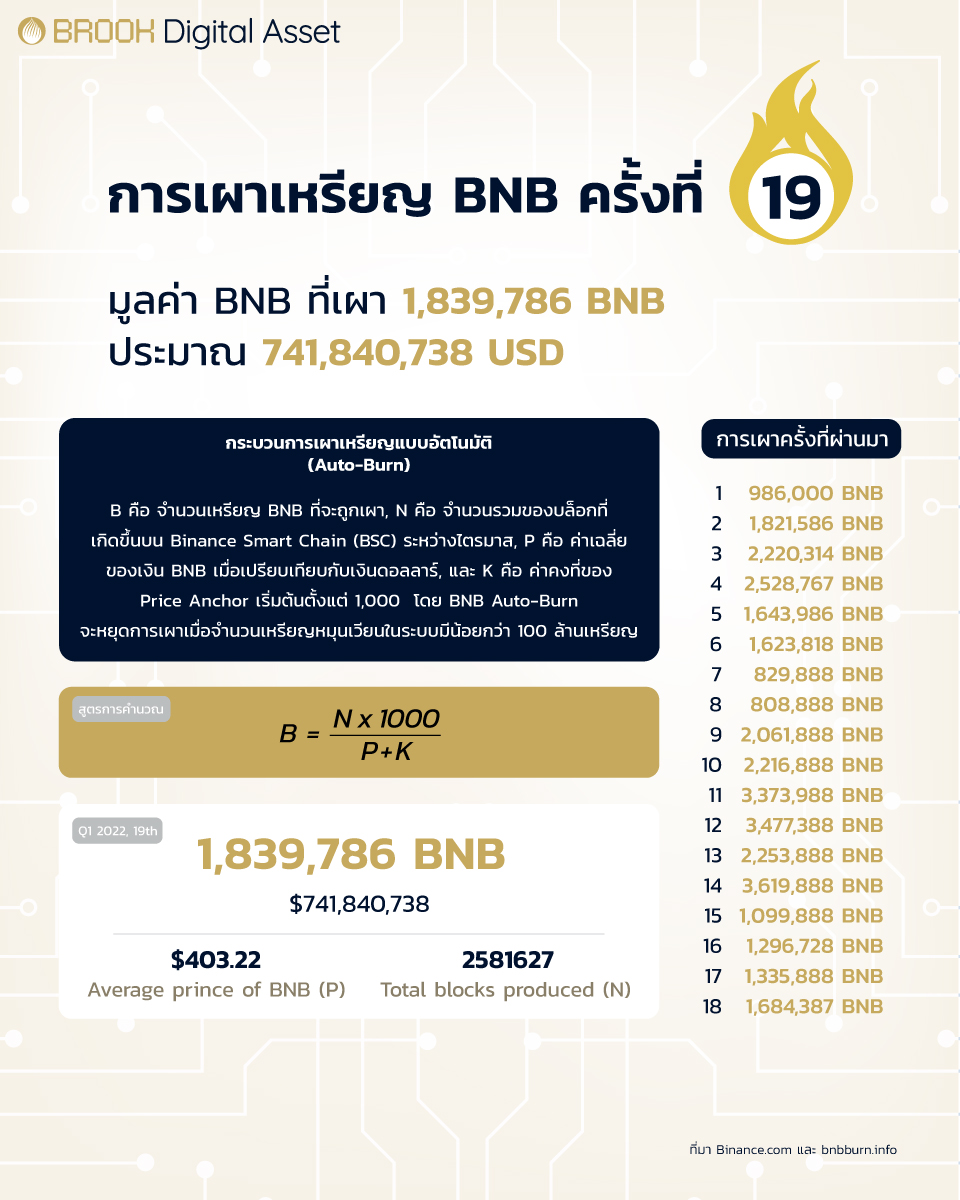
On April 19, Binance burned 1,839,786.26 BNB from circulation for the first quarter of 2022 using its automatic token-burning mechanism, BNB Auto-Burn. The tokens were worth approximately US$741,840,738.874. This was the 19th BNB burn and the second to use the BNB Auto-Burn mechanism.
The Binance Smart Chain (BSC) ecosystem and how BNB burning works
Within the blockchain technology ecosystem, BNB functions as a Native Token and is used to pay transaction fees, or gas, on Binance Smart Chain (BSC), in much the same way that gas is used on Ethereum. BNB also supports decentralized governance participation across the BSC network, although Binance does not control how BSC operates.
Binance Smart Chain (BSC) is supported by its community of users, developers and validators and delegators. BNB transaction fees, or gas fees, are also accepted for payments and can be exchanged for other assets. This enables BNB to operate within the BSC ecosystem and has contributed to the popularity of both BNB and BSC. Binance therefore introduced BNB Auto-Burn as a mechanism designed to support the operation of BSC and preserve the value of BNB for its community. As a result, the price of BNB is no longer dependent on Binance’s profits, but instead on the volume and level of activity taking place on Binance Smart Chain.
There are currently two BNB-burning mechanisms. The first is the real-time burning of transaction fees, or gas fees, generated by use of Binance Smart Chain (BSC), known as BEP95. Approximately 860 BNB are burned each day. The second is the quarterly BNB Auto-Burn mechanism. The latest burn was the 19th, involving a total of 1,839,786.26 BNB.
The automatic burning mechanism operates every quarter. Its purpose is to ensure that the process remains independent of Binance’s revenue generation through the use of BNB. The amount burned automatically is adjusted based on the price of BNB, which reflects token supply and demand, as well as the number of blocks produced during the quarter. The calculation is based on blockchain data, using the following formula:
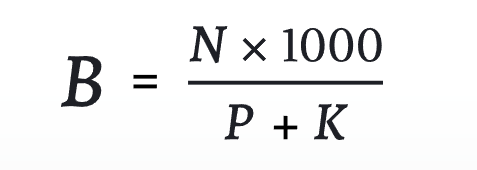
B is the amount of BNB to be burned; N is the total number of blocks produced on Binance Smart Chain (BSC) during the quarter; P is the average price of BNB against the US dollar; and K is the Price Anchor constant, initially set at 1,000. BNB Auto-Burn will stop once the number of BNB in circulation falls below 100 million.
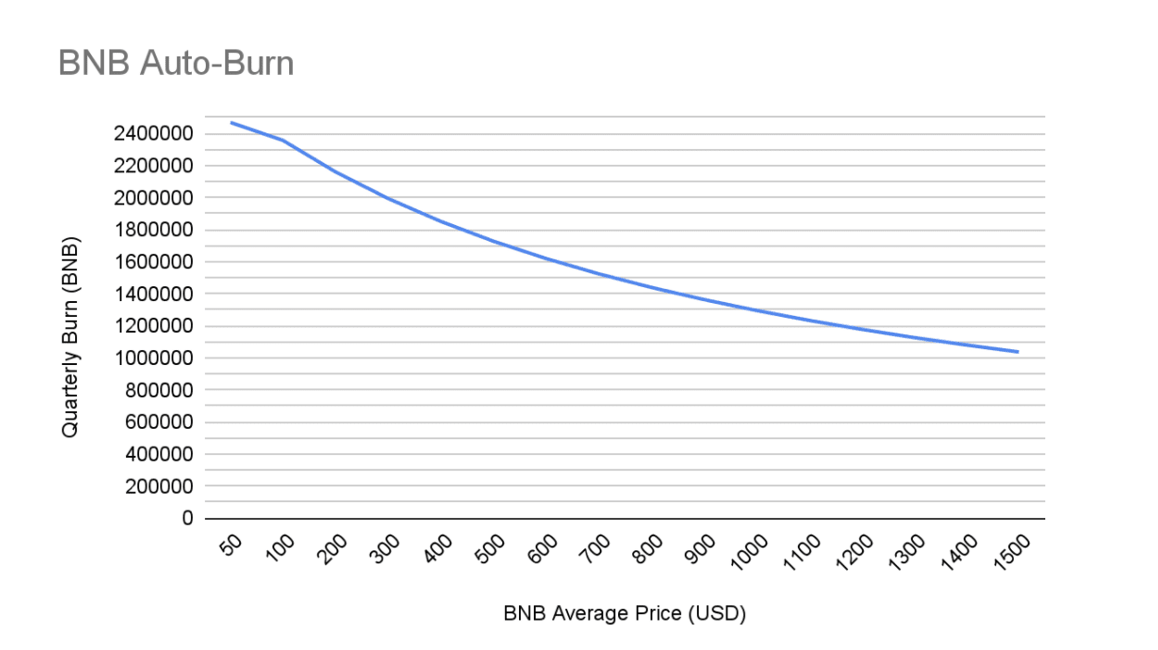
The chart shows the projected trend for BNB being burned through the automatic mechanism, comparing the amount burned with the average BNB-to-US-dollar exchange rate.
Since Binance and BNB were launched in 2017, the company has focused on developing and improving their operations based on feedback from users and developers. Binance believes that introducing automatic BNB burning is an important step for BNB and BSC, providing a key foundation for strengthening the blockchain ecosystem.
Previous burns have aimed to remove 100 million BNB, or half of the total supply. The pace of the burns depends on trading volume, meaning the time required to complete the process may vary.
According to Binance’s calculations, the burning process could take approximately 27 years to complete, although the actual period could be longer or shorter and cannot be calculated precisely. To date, 18.42% of BNB, or approximately 36,860,000 BNB, has been burned. If trading activity continues to grow at a similar pace, reducing the circulating supply to below 100 million BNB could take approximately five to eight years. This period may also change. These figures suggest a positive outlook for BNB: reducing supply could benefit the token over the long term, help guard against inflation and potentially increase its value.
Source https://bnbburn.info/
https://www.binance.com/en/blog/ecosystem/introducing-bnb-autoburn-a-new-protocol-for-the-quarterly-bnb-burn-421499824684903205