
China’s digital currency is not a path toward cryptocurrency, but a future financial system for the country.
02/06/2022
Highlight
- Lucky recipients will receive digital red envelopes, a symbol of good fortune, containing 88, 100 or 128 digital yuan.
- Shenzhen will be the first city to pilot the digital yuan. It is an official digital currency that can be used to pay for goods and services, in cooperation with the central government in developing the digital currency.
- Because cryptocurrency is banned in China, the digital yuan is not a digital currency in the form commonly understood by the public. Instead, it is designed to facilitate users’ transactions and stimulate the new digital economy.
- China’s efforts to develop the digital yuan have raised concerns among governments and the public worldwide, including over potential violations of privacy through government surveillance and geopolitical tensions as countries seek to counterbalance US economic power by promoting the digital yuan as an alternative to the US dollar.
Shenzhen, China, has decided to distribute 30 million digital yuan (e-CNY), worth approximately 154 million baht, to stimulate the economy during the downturn caused by the Coronavirus Disease 2019 pandemic.
Residents of the southern city were able to register for the first round through the Meituan app on Monday, May 30, and Wednesday, June 1. The results were to be announced on Thursday, June 2, 2022, while the second round was scheduled to begin on June 9.
Lucky recipients will receive digital red envelopes containing 88, 100 or 128 digital yuan, which can be used to purchase goods and services, including convenience-store products, food-delivery services and bicycle rentals, through more than 15,000 merchants on Meituan. The funds can also be spent offline. In addition, users who spend more than the amount received can top up their e-CNY wallets or conduct transactions through other third-party apps, including Alipay and WeChat.
Shenzhen thus became the first city to officially use the digital yuan. Spending to pay for goods and services is known as Digital Currency Electronic Payment (DCEP). This digital yuan pilot is a collaboration between the People’s Bank of China and leading research institutions in Beijing and Suzhou. After this, additional digital red envelopes will be distributed in Guangzhou, where authorities plan to distribute another 10 million digital yuan to stimulate local consumption.
The origins of the digital yuan
The Chinese government’s digital currency system began in 2014, when the People’s Bank of China started developing the digital yuan (e-CNY), also known as Digital Currency Electronic Payment. Its exchange rate is equivalent to that of the yuan. The initiative is considered the world’s first government-issued digital currency, created to provide consumers with a new form of currency for online spending.
“The digital yuan was initially created to stimulate the new digital economy and build an efficient system for finance, banking, and payments for goods and services.” This was the central message of the White Paper issued by the People’s Bank of China.
The People’s Bank of China began researching digital currencies in 2014, including studies conducted after China launched its first payment app in December of the previous year. The introduction of this payment method helped increase its popularity among Chinese consumers. A major trial of the digital yuan took place during the 2022 Summer Olympic Games and Winter Paralympic Games.
Past use has demonstrated that the currency can be used through a variety of applications and at a wide range of merchants, including retailers, restaurants and tourism businesses, as well as for paying fees and other services. Members of the public can use it easily by scanning a QR code with a smartphone.
In 2021, transactions using the digital yuan totaled more than 87.57 billion yuan, or approximately 460 billion baht.
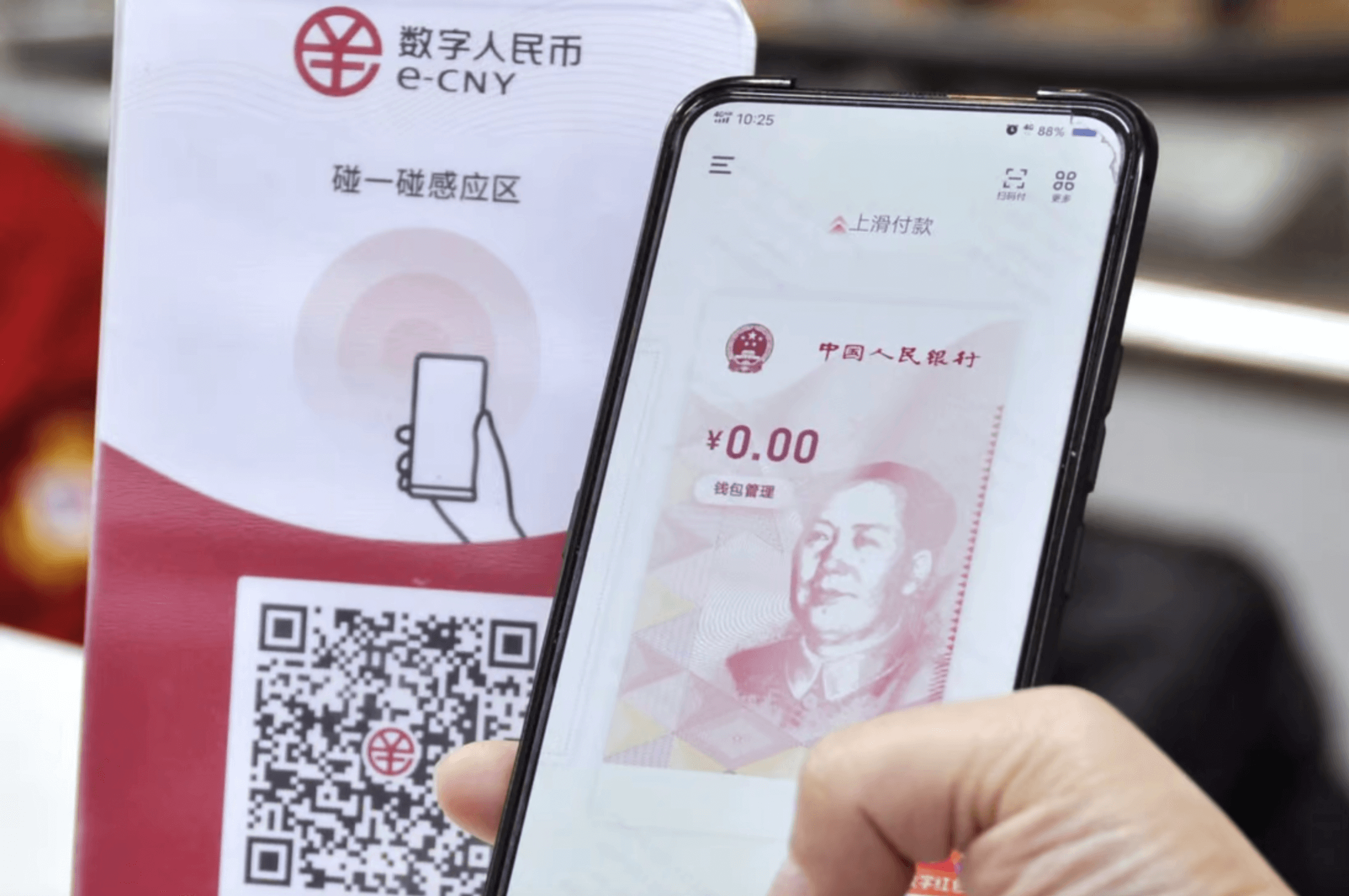
Use of the digital yuan by scanning a QR code during a trial on December 14, 2021.
(Source: South China Morning Post)
US applications and the negative outlook for digital yuan payments
Although the government has continued to advance its own digital currency, obstacles remain. Bitcoin is still not legal in China, despite efforts to conduct pilot projects and build on them.
The expansion of Digital Currency Electronic Payment (DCEP) in China has drawn significant attention from US legal authorities. Orders have been issued prohibiting US application platforms from conducting transactions using the digital yuan, reflecting concerns over efforts to counterbalance US economic power. Previously, the digital yuan initiative was viewed as an attempt by the Chinese government to become a global leader in the digital economy, although it remained an unofficial approach.
Will the digital yuan become a cryptocurrency?
While the Chinese government has sought to create a blockchain platform as a means of developing blockchain technology for companies, the digital yuan is not part of a plan to create a cryptocurrency. The Chinese government has warned of the risks and dangers associated with the instability posed by cryptocurrencies such as Bitcoin, leading to orders to shut down companies involved in software and services for trading digital currencies. Even major platforms such as AliPay and WeChat Pay have avoided providing cryptocurrency trading services, while all Bitcoin-mining operations were banned in 2021.
Concerns over the digital yuan
Financial professionals, investors and governments around the world are currently expressing serious concerns about and closely monitoring the digital yuan. In particular, there are fears that the Chinese government could use the digital yuan for Government Surveillance. Many academics have also suggested that the Chinese Communist Party could use transaction data to track the flow of users’ digital yuan, since the currency operates directly under the People’s Bank of China. This differs from cryptocurrencies, whose systems have no central intermediary monitoring transactions.
Analysts also view the digital yuan’s growing role as part of an effort to counterbalance the US dollar, which has long served as the world’s dominant reserve currency. At the same time, the Chinese government is seeking to build a more efficient financial system and a new payment system for the public by allowing the central bank to operate a system suited to the digital era.
Sources https://www.scmp.com/tech/tech-trends/article/3179824/china-digital-currency-shenzhen-hands-out-e-cny-vouchers-worth
https://www.fxstreet.com/analysis/how-far-along-is-china-into-testing-its-digital-currency-202206010226
https://techwireasia.com/2022/05/the-wests-fears-on-chinas-digital-yuan-escalates-with-a-ban/
https://www.reuters.com/markets/currencies/china-uses-digital-yuan-stimulate-virus-hit-consumption-2022-05-30/
https://bitcoinist.com/china-airdrop-digital-yuan-boost-pandemic-economy/