
News
The Brutal May Bear Market and the Highest Fear in a Year Since the Coronavirus Outbreak in March 2020
17/06/2022
This article is not investment advice. It is intended solely as a study and compilation of relevant documents.
The author researched and wrote this article in May. Accordingly, some information may have changed or may be inaccurate. Readers should study the information carefully and exercise sound judgment.
Highlight
- On May 17, 2022, and June 15, the Fear & Greed Index fell to its lowest level of 8, representing the most extreme fear seen in two years, since the coronavirus outbreak in March 2020 (updated June 14, 2022: Extreme Fear at 17).
- Historical data for the index shows that an Extreme Fear reading of 8 or below has occurred three times: in February 2018 (when BTC fell to $6,000), August 2019 (when BTC fell to $9,320), and March 2020 (when BTC fell to $3,782).
- A survey of investors by the American Association of Individual Investors (AAII) found that, amid the highest global inflation in 40 years, 49% believed the investment market would remain in contraction for another six months.
- After the Fed announced another 0.50% interest-rate hike, its second rate increase of 2022, and amid the Russia-Ukraine conflict, fund managers reported that cash holdings had reached their highest level since the September 11 attacks.
The CNN Business Fear & Greed Index showed Extreme Fear during May. Looking at the statistics over the 45 days from April onward, the Crypto Fear and Greed Index (CFGI) remained at 22, while on May 17 it fell to 8, the lowest extreme-fear reading in two years since the coronavirus outbreak in March 2020. The index reflects several factors, including Bitcoin price volatility, investment flows, market trading volume, social-media activity and crypto-asset market capitalization.
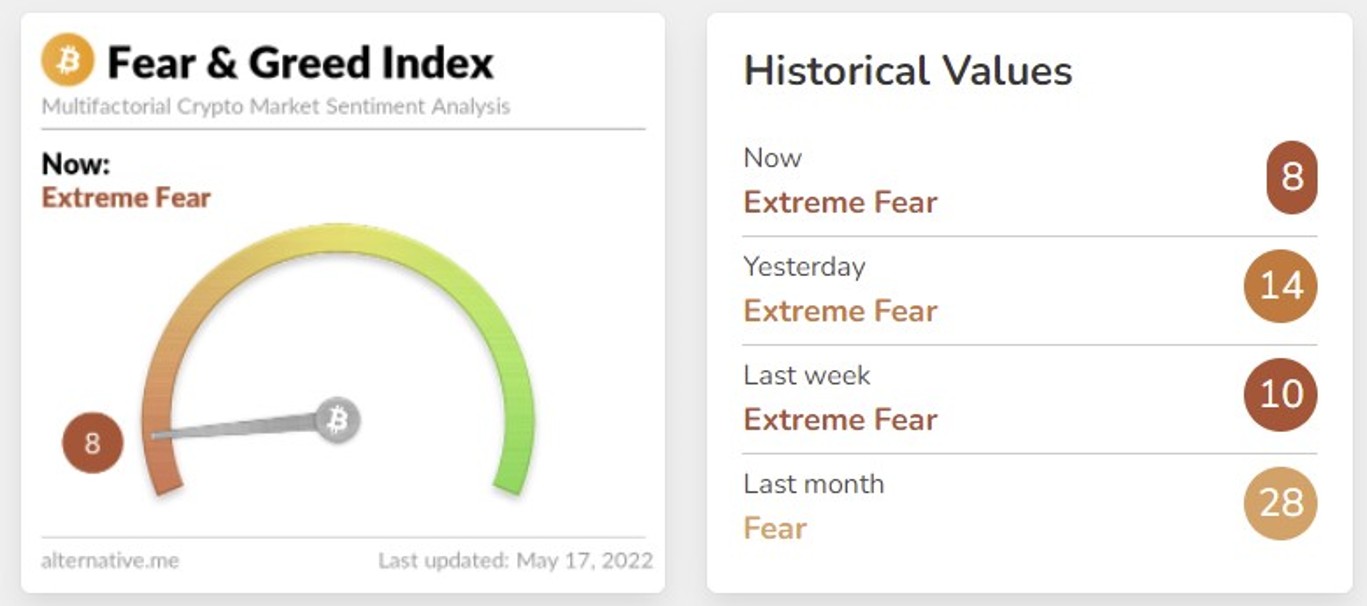
Fear & Greed Index at 8 (May 17, 2022)
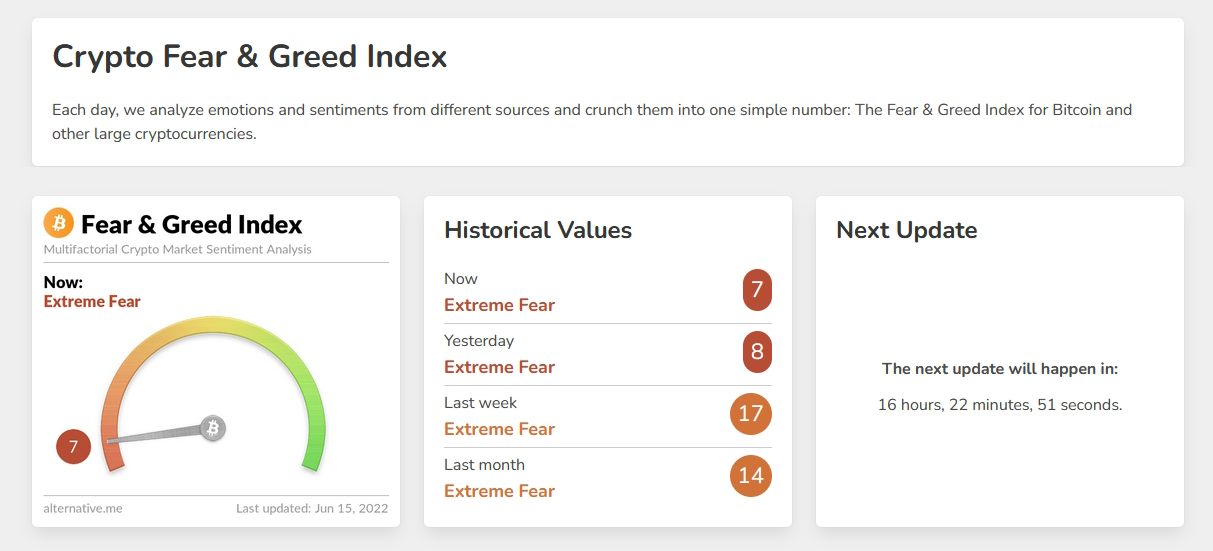
Fear & Greed Index at 8 (June 15, 2022)
** Note: The Fear & Greed Index is a tool that measures fear and greed, indicating levels that affect market confidence and investor behavior. Read more at https://www.facebook.com/BrookDigitalAsset/posts/293994936180435
Factors Behind Fear and Events During the Bear-Market Hibernation
A survey of investors by the American Association of Individual Investors (AAII) found that 49% believed the investment market would remain in contraction for another six months, while another 31% viewed conditions as normal market conditions. In addition, a survey of Bank of America fund managers indicated that this would be a period of a ‘severe May bear market.’
The warning signs came from several sources: global inflation at its highest level in 40 years; Federal Reserve Chair Jerome Powell’s decision to raise interest rates by another 0.50%, marking the second rate increase of 2022; and the Russia-Ukraine conflict. Fund managers reported that cash holdings had reached their highest level since the September 11 attacks.
The turning point for Bitcoin and other cryptocurrencies in May was the U.S. Federal Reserve’s interest-rate announcement, which triggered widespread profit-taking in Bitcoin and marked the beginning of a decline in cryptocurrency prices alongside technology stocks.
This was compounded by the UST and LUNA crisis, which caused UST to fall below its $1 peg and subsequently undermined LUNA. According to a Bank of America report, the event generated significant fear among crypto investors, comparable to the bursting of the technology-market bubble and the global financial crisis of 2008.
On the other hand, some investors viewed the event as an opportunity to invest and use strategies to profit during a declining market. According to CoinShares, although prices had fallen, weekly trading activity remained as high as $45 million (updated May 6).
Fear & Greed Index Hits a Two-Year Low Since the Coronavirus Outbreak in March 2020
Alternative.me (add hyperlink https://alternative.me/crypto/fear-and-greed-index/ ) shows the Fear & Greed Index at 8 on a scale of 0-100. Historical data shows that an Extreme Fear reading of 8 or below had previously occurred three times (circled in red in the image below): February 2018 (when BTC fell to $6,000), August 2019 (when BTC fell to $9,320), and March 2020 (when BTC fell to $3,782).
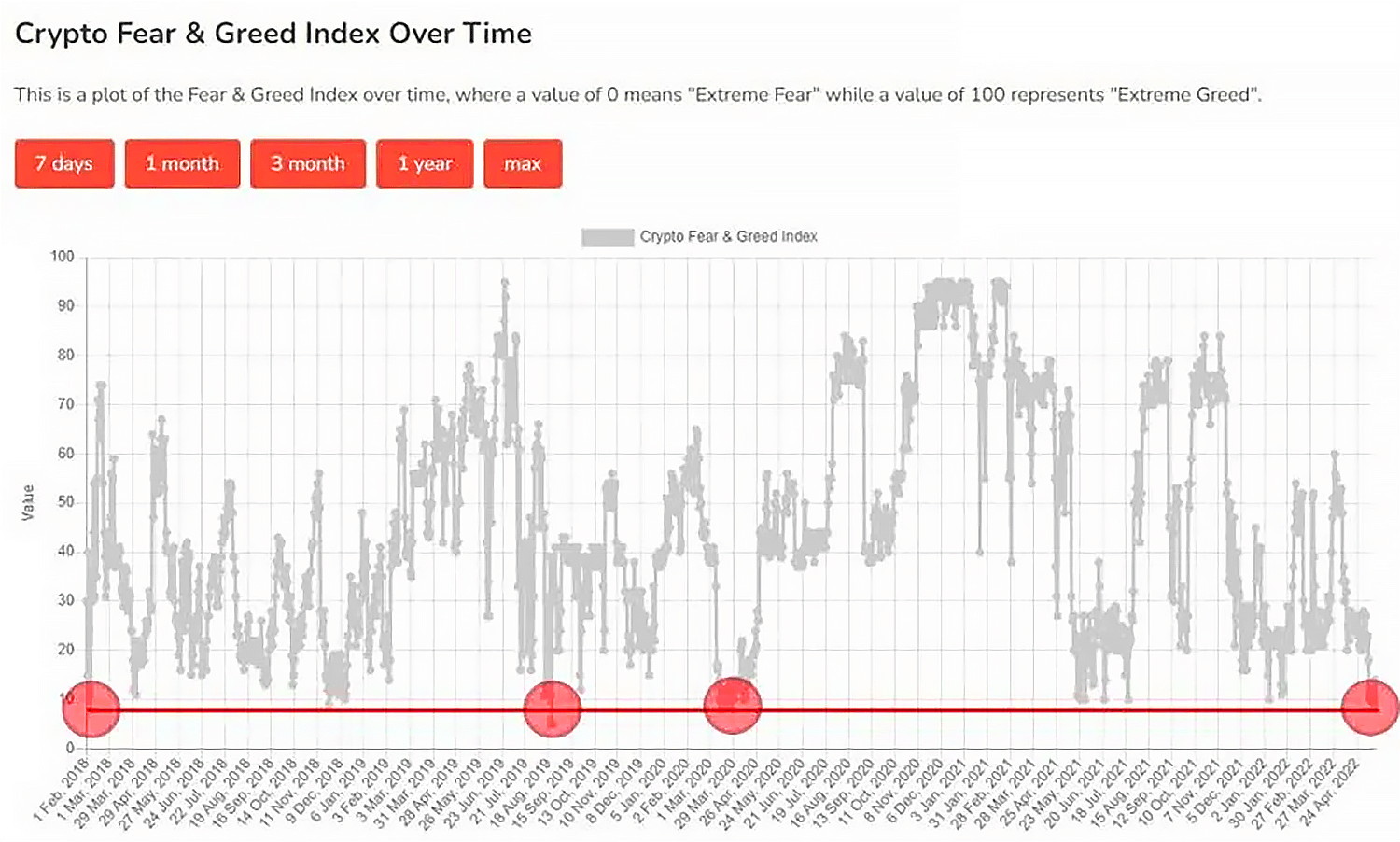
During the previous bear market, Bitcoin fell to $3,156 in December 2018, causing the fear index to reach 9. On May 17, it stood at 8, which can be described as the fourth extreme-fear event since the Fear & Greed Index was created.
Research using the Fear & Greed Index shows that fear often emerges when BTC prices fall. However, despite this pattern, it remains unclear whether BTC prices will decline further. Crypto analyst @Pladizow (https://twitter.com/Pladizow) explained the Bitcoin price declines that triggered fear (as shown in the image below), identifying four instances in history that produced very low readings (the March 2020 event appears twice in the chart). The study also noted that, in the first two instances when the index indicated extreme fear, Bitcoin prices fell substantially further before reversing.
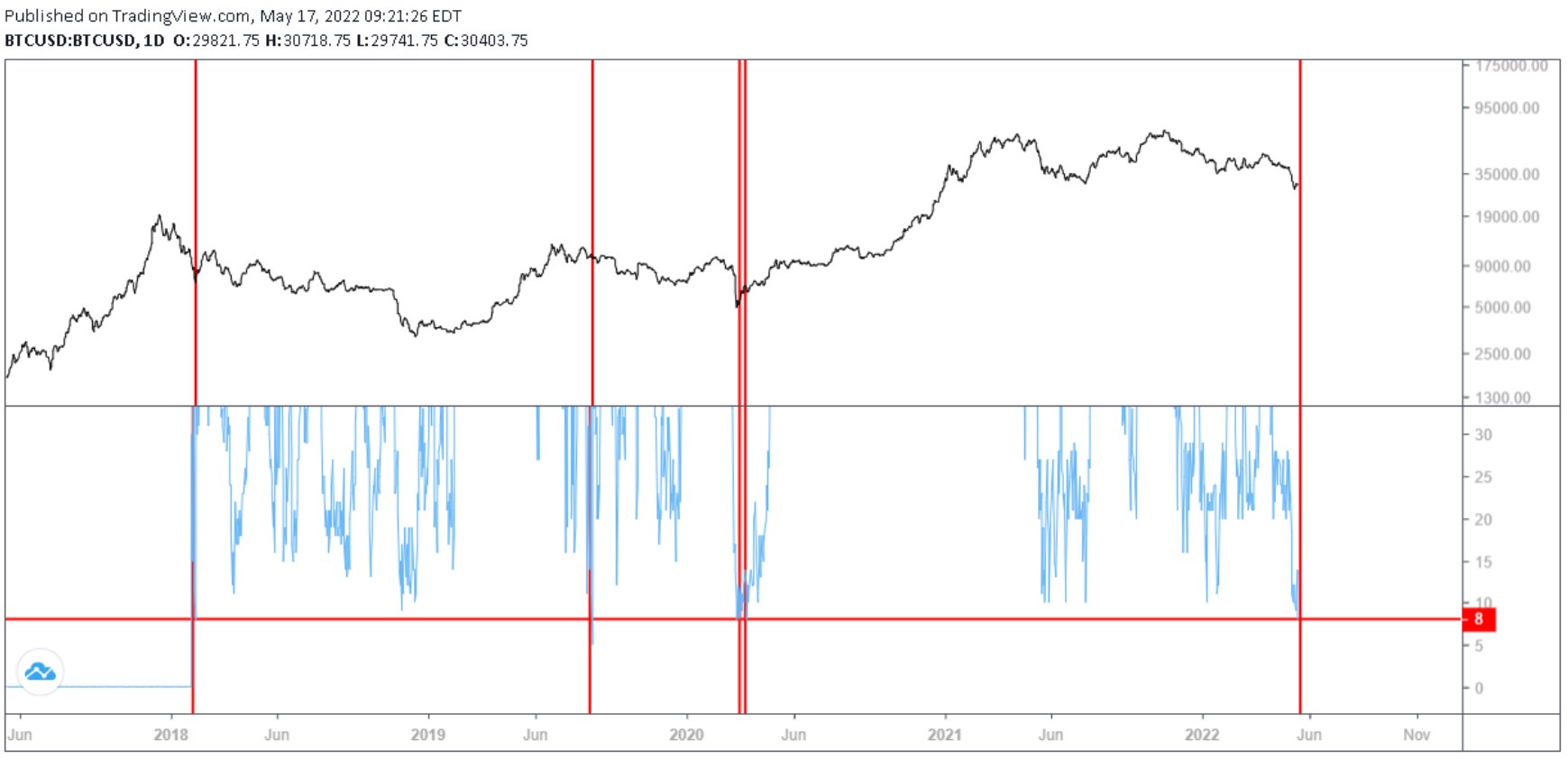
Source: https://twitter.com/Pladizow/status/1526554514953838593
Another chart from LookIntoBitcoin.com shows the fear index. The colors represent Bitcoin prices that generated different levels of fear during each period. The dark-red areas indicate periods when Bitcoin prices had fallen sharply. However, after the fear index subsided, the index gradually shifted toward greed, shown in green, as Bitcoin prices began to rise. This occurred, for example, in April 2021 and November 2021. After extreme fear eased, Bitcoin prices rose approximately two weeks to one month later.
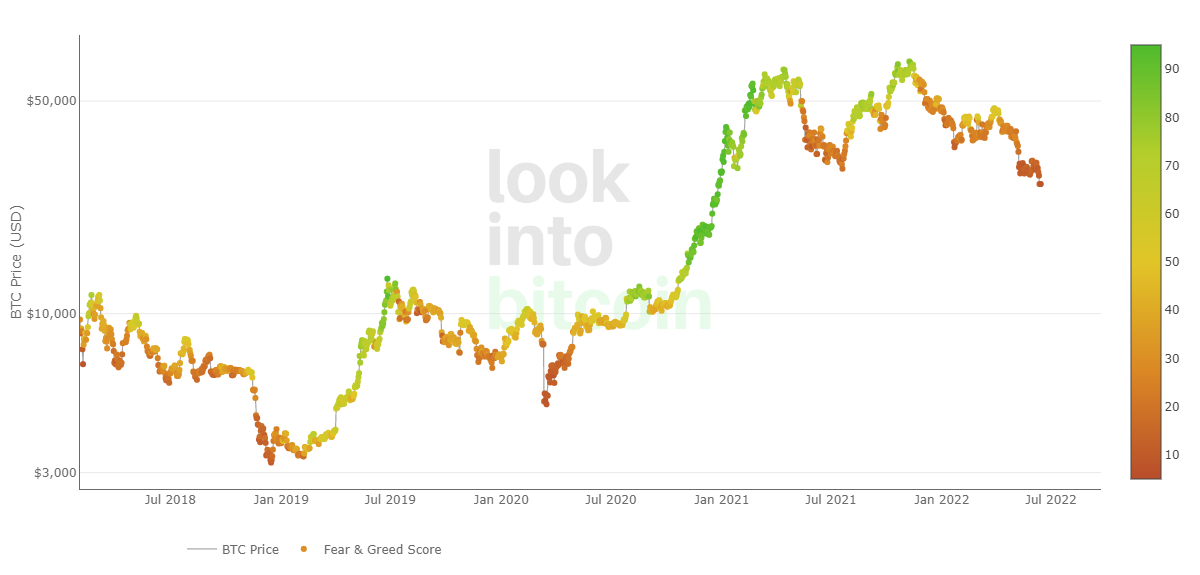
Based on the above, interpreting the current Fear and Greed Index reading, with extreme fear at a very low level, may not signal that the market is approaching its bottom. Therefore, interpreting extreme fear in the market as a short-term trading signal may be a flawed strategy, because the Fear and Greed Index only indicates levels of fear and greed that affect market confidence and investor behavior.
Nevertheless, the negative sentiment that has emerged is something investors should monitor more closely in markets considered risky or subject to negative momentum, while patiently looking for investment opportunities that align with reality.
Sources:
https://edition.cnn.com/2022/05/18/investing/premarket-stocks-trading/index.html
https://fortune.com/2022/05/17/bitcoin-crypto-fear-greed-index-lowest-level-since-march-2020/
https://finance.yahoo.com/news/crypto-fear-greed-index-hits-185112144.html
https://beincrypto.com/fear-and-greed-index-hits-8-lowest-since-covid-19-crash-of-march-2020/